

You’ve spent weeks perfecting your landing page design. Traffic is flowing in steadily. But here’s the harsh reality: most of your visitors are leaving without converting. Sound familiar? You’re not alone. The average landing page conversion rate hovers around 2.35%, meaning 97 out of 100 visitors vanish without taking action.
What if you could flip that script with a few strategic tweaks? The good news is that you don’t need a complete redesign or a massive budget to dramatically improve your results. These conversion rate optimization hacks can transform your underperforming landing page into a lead-generating machine, often within hours of implementation.
Understanding Conversion Rate Optimization Before You Start
Before diving into specific tactics, let’s establish what makes CRO different from other marketing strategies. Conversion rate optimization is the systematic process of increasing the percentage of website visitors who complete a desired action, whether that’s filling out a form, making a purchase, or clicking through to another page.
Unlike paid advertising that focuses on driving more traffic, these simple CRO tactics work with the visitors you already have. That’s what makes them so powerful for beginners and experienced marketers alike. You’re essentially getting more results from the same investment.
Hack #1: Craft Headlines That Speak Directly to Pain Points
Your headline is the first thing visitors see, and it determines whether they’ll stay or bounce within seconds. Generic headlines like “Welcome to Our Service” waste this critical opportunity.
Creating High-Converting Headlines
The most effective headlines immediately communicate value and address specific problems your audience faces. Instead of talking about your company, talk about what your visitor will gain. For example, rather than “Industry-Leading Software Solutions,” try “Cut Your Project Management Time in Half Without Adding Staff.”
Test different headline formulas: ask compelling questions, make bold promises backed by proof, or use numbers to create specificity. A headline like “How 3,000+ Businesses Reduced Customer Churn by 43%” combines social proof with concrete results.
Hack #2: Eliminate Friction with a Single, Crystal-Clear Call to Action
One of the most common landing page mistakes is offering visitors too many choices. When you present multiple CTAs or navigation options, you create decision paralysis. People simply leave rather than choose.
Your landing page should have one primary goal and one dominant CTA that supports it. Every element on the page should guide visitors toward that single action. Remove navigation menus, sidebar links, and competing offers that might distract from your main conversion goal.
Optimizing Your CTA Button
Your call to action button deserves special attention. Use action-oriented, first-person language that emphasizes the benefit. Replace generic phrases like “Submit” or “Click Here” with specific value statements like “Get My Free Analysis” or “Start Saving Money Today.”
The color, size, and placement of your CTA button also matter. Position it above the fold and repeat it strategically throughout longer pages. Make sure it contrasts sharply with your background color so it’s immediately noticeable.
Hack #3: Leverage Social Proof to Build Instant Credibility
New visitors don’t know whether to trust you. Social proof shortcuts that trust-building process by showing that others have already taken the leap successfully.
Incorporate testimonials, customer reviews, case studies, trust badges, client logos, and user statistics prominently on your landing page. The more specific and relevant these elements are to your visitor’s situation, the more powerful they become.
Making Social Proof More Effective
Generic praise falls flat. Instead of “Great service!” showcase detailed testimonials that describe the problem someone faced, how your solution helped, and the specific results they achieved. Include names, photos, and company details when possible to boost authenticity.
Video testimonials convert even better than text because they’re harder to fake and create emotional connections. If you can capture just 30 to 60 seconds of a satisfied customer explaining their experience, you’ll see measurable improvements in conversion rates.
Hack #4: Simplify Your Forms to Reduce Abandonment
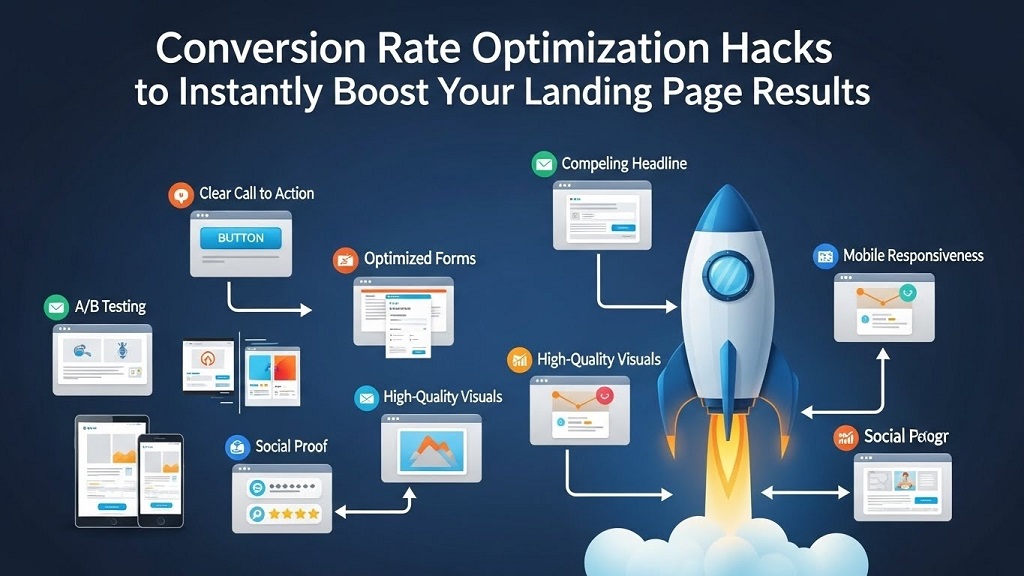
Every form field you add decreases your conversion rate. Research consistently shows that shorter forms convert better because they require less effort and feel less invasive.
Ask yourself: which information do you absolutely need right now versus what you can gather later? For most lead generation campaigns, a name and email address are sufficient for the initial conversion. You can collect additional details through email sequences or during sales calls.
Form Design Best Practices
Beyond reducing fields, optimize your form design for usability. Use clear labels, provide helpful placeholder text, and indicate which fields are required. Show real-time validation so users know immediately if they’ve made an error rather than discovering it after clicking submit.
For longer forms that can’t be shortened, consider multi-step forms that break the process into manageable chunks. This approach often increases completion rates because each individual step feels less overwhelming.
Hack #5: Create Urgency Without Being Manipulative
Urgency and scarcity are powerful psychological triggers, but they must be authentic to work without damaging trust. False scarcity tactics will eventually backfire and harm your brand reputation.
Legitimate urgency might include limited-time discounts, seasonal offers, enrollment deadlines, or inventory constraints. When these limitations are real, communicate them clearly. A simple countdown timer showing when an offer expires can boost conversions significantly.
Scarcity works because of loss aversion—people are more motivated by the fear of missing out than by potential gains. Frame your offer to highlight what visitors will lose by not acting, not just what they’ll gain by converting.
Hack #6: Optimize Page Speed for Impatient Visitors
Page speed directly impacts conversion rates. Studies show that a one-second delay in page load time can reduce conversions by up to seven percent. When visitors wait too long, they simply leave.
Use tools like Google PageSpeed Insights to identify specific issues slowing down your landing page. Common culprits include oversized images, unnecessary plugins, unoptimized code, and slow server response times.
Quick Speed Improvements
Compress all images before uploading them. Switch to modern image formats like WebP that offer better compression. Enable browser caching so returning visitors load your page faster. Consider a content delivery network to serve resources from servers closer to your visitors’ locations.
These CRO tips for beginners are technically simple but create measurable improvements in both user experience and conversion rates.
Hack #7: Use Visual Hierarchy to Guide Attention
The way you arrange elements on your landing page determines what visitors notice and in what order. Strong visual hierarchy uses size, color, contrast, and positioning to direct attention toward your most important conversion elements.
Your headline should be the largest text element. Your CTA button should use a contrasting color that makes it impossible to miss. Supporting elements like testimonials and features should be clearly subordinate in visual weight.
Whitespace is one of the most underutilized tools in landing page design. Rather than cramming every pixel with content, use generous spacing to make your page feel less cluttered and help important elements stand out.
Hack #8: Mobile Optimization Is Non-Negotiable
More than half of web traffic now comes from mobile devices, yet many landing pages still provide terrible mobile experiences. If your page isn’t fully responsive and optimized for small screens, you’re losing massive conversion opportunities.
Test your landing page on actual mobile devices, not just desktop browser simulators. Check that buttons are large enough to tap easily, forms work smoothly with mobile keyboards, and all content is readable without zooming or horizontal scrolling.
Mobile-Specific Considerations
Mobile users have different contexts and behaviors than desktop visitors. They’re often on the go, have less patience for long content, and may be using slower connections. Simplify your mobile experience even further than your desktop version. Consider click-to-call buttons that let mobile users contact you immediately rather than filling out forms.
Hack #9: Implement Exit-Intent Popups Strategically
Exit-intent technology detects when visitors are about to leave your page and triggers a last-chance offer at that precise moment. While popups can be annoying when overused, exit-intent popups specifically target people who are already leaving, so they don’t disrupt engaged visitors.
Use exit-intent popups to offer discounts, free resources, or alternative conversion paths that might appeal to hesitant visitors. Keep the message concise and the offer compelling enough to make someone reconsider leaving.
The key is providing genuine value rather than just begging people to stay. A popup offering a helpful checklist, template, or guide related to your main offer often performs better than discount-focused messages.
Measuring and Improving Your Results
Implementing these conversion rate optimization hacks is just the beginning. The most successful marketers continuously test and refine their approaches based on real data.
Set up proper analytics to track not just conversion rates but also micro-conversions like scroll depth, time on page, and button clicks. These metrics help you understand where visitors engage and where they drop off.
A/B testing lets you compare different versions of specific elements to see what actually works for your unique audience. Test one change at a time so you can identify which modifications drive improvements. Even small gains compound over time into substantial increases in leads and sales.
Remember that CRO is not a one-time project. Markets change, audiences evolve, and competitors adapt. The landing pages that convert best are those that their owners continuously optimize based on performance data and customer feedback.
Start Boosting Your Conversions Today
You now have nine proven conversion rate optimization hacks that can transform your landing page performance. The beauty of these simple CRO tactics is that most require minimal technical skills and can be implemented quickly.
Don’t try to tackle everything at once. Start with the changes that address your biggest weaknesses or seem most relevant to your specific situation. Even implementing just two or three of these strategies can produce noticeable improvements in your conversion rates.
Ready to see real results? Choose one hack from this list and implement it on your landing page this week. Monitor your conversion rate carefully, measure the impact, and then move on to the next optimization. Your future self will thank you for taking action today rather than waiting for the perfect moment that never comes.
What conversion optimization challenge are you facing right now? Take the first step toward better results by applying these CRO tips for beginners and watching your landing page transform from a traffic destination into a conversion powerhouse.
Frequently Asked Questions About Conversion Rate Optimization
What is a good conversion rate for a landing page?
A good conversion rate varies by industry and offer type, but generally, landing page conversion rates between 5-10% are considered above average. Top-performing pages can achieve 20-30% or higher. Focus on improving your own baseline rather than obsessing over industry benchmarks.
How long should I run a test before making changes?
Run tests for at least one to two weeks or until you reach statistical significance with enough data. You need at least 100 conversions per variation to draw reliable conclusions. Ending tests too early leads to false positives that waste time on changes that don’t actually work.
Do I need expensive tools to implement these CRO hacks?
No. Most of these conversion rate optimization hacks can be implemented with basic website editing skills and free tools. Google Analytics provides essential tracking, and many website builders include A/B testing features. Invest in paid tools only after you’ve exhausted free options and proven that CRO produces returns worth expanding.
Can I use multiple CTAs on a single landing page?
While one primary CTA is ideal, longer landing pages can repeat the same CTA at strategic points as visitors scroll. What you should avoid is offering different conversion paths that compete with each other. Every CTA should drive toward the same goal.
How often should I update my landing page?
Review your landing page performance monthly and make data-driven updates quarterly. Major redesigns aren’t necessary often, but continuous small improvements compound into significant gains. Always base changes on performance data rather than design trends or personal preferences.


