

Taking your bikes on adventures should be exciting, not stressful. However, choosing the wrong bike rack for your SUV can lead to scratched paint, damaged bumpers, and even safety hazards on the road. The good news is that with the right information, you can select a rack that protects your vehicle while securely transporting your bikes.
SUVs present unique challenges when it comes to bike transportation. Their height, weight capacity, and rear-door access all factor into which rack will work best. Additionally, the investment you’ve made in your vehicle deserves protection from scratches, dents, and unnecessary wear.
This comprehensive guide will walk you through everything you need to know about selecting a hitch-mounted bike rack that works perfectly with your SUV. You’ll learn about weight capacities, installation methods, protective features, and maintenance tips that keep both your bikes and vehicle in pristine condition.
Understanding Your SUV’s Hitch Receiver
Before shopping for any bike rack, you need to understand your vehicle’s hitch receiver. This component determines which racks are compatible with your SUV and how much weight you can safely carry.
Most modern SUVs come equipped with either a 1.25-inch or 2-inch hitch racks receiver. The measurement refers to the inside dimensions of the square receiver tube. Larger receivers generally support more weight, though this isn’t always the case.
Check your vehicle’s owner’s manual for the tongue weight rating. This specification indicates how much downward force the hitch can handle. Bike racks add weight both from their own structure and from the bikes they carry. Therefore, you must ensure the combined weight stays within this limit.
The hitch class also matters significantly. Class I and II hitches typically handle lighter loads, while Class III and IV hitches support heavier bike racks and more bikes. Your SUV likely has a Class III or IV hitch, which opens up more options for bike transportation.
Location of your hitch affects ground clearance and accessibility. Some SUVs have hitches mounted higher, which can impact how low the rack hangs. Measure the distance from the ground to the center of your hitch receiver to ensure adequate clearance with a loaded rack.
Platform Style Versus Hanging Racks
Two main styles dominate the hitch bike rack market, each with distinct advantages and considerations for SUV owners. Understanding these differences helps you choose the design that best suits your needs.
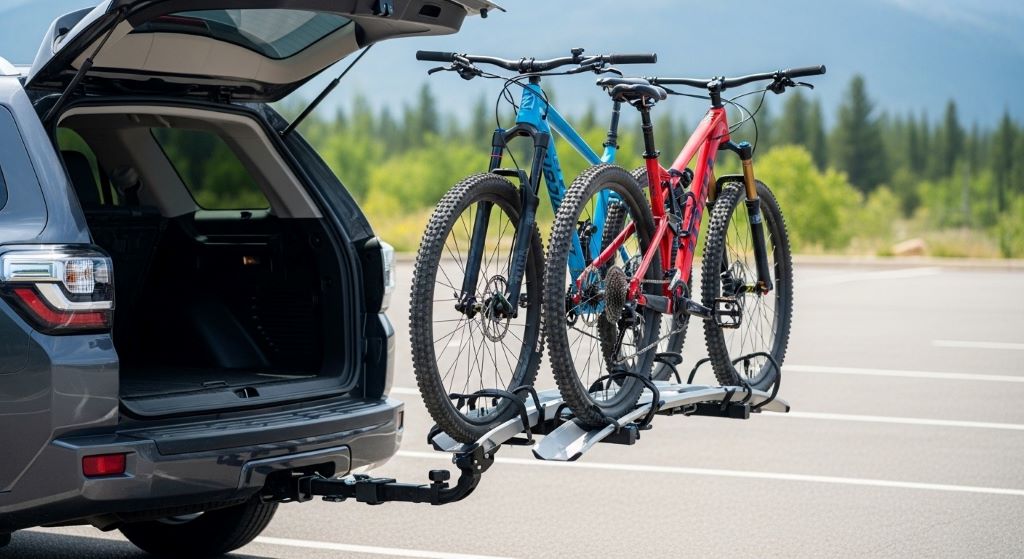
Platform racks support bikes by their wheels, eliminating frame contact entirely. This design prevents paint scratches on bike frames and works with virtually any bike style, including those with non-traditional frame shapes. The bikes stand upright, making loading and unloading straightforward.
These racks generally cost more than hanging alternatives but offer superior stability and ease of use. They typically tilt away from the vehicle for rear access, which becomes particularly important for SUVs where you frequently need to open the rear door or liftgate.
Hanging racks suspend bikes from their top tubes using arms with protective cradles. They’re more compact when not in use and usually cost less than platform designs. However, they require more careful installation to prevent bike-to-bike contact and may not accommodate certain frame styles.
For SUVs, the added stability of platform racks often justifies the higher price. The weight of mountain bikes or electric bikes can cause hanging racks to sway more, potentially contacting your vehicle’s bumper or rear door.
Weight Capacity Considerations
Understanding weight limits prevents damage to your vehicle and ensures safe transportation. Multiple weight factors come into play when selecting a bike rack for your SUV.
Individual bike weight capacity varies between racks. Standard racks handle bikes up to 35 pounds each, which works fine for road bikes and basic mountain bikes. However, modern e-bikes and downhill mountain bikes often exceed this limit.
Heavy duty bike racks are engineered to support bikes weighing 50 to 70 pounds each. If you own or plan to purchase electric bikes, these robust designs become necessary rather than optional. They feature reinforced construction and stronger attachment points.
Total rack capacity combines the weight of all bikes the rack can carry simultaneously. A four-bike rack rated for 60 pounds per bike can theoretically carry 240 pounds total. However, always verify that this total doesn’t exceed your vehicle’s tongue weight rating.
Don’t forget to include the rack’s own weight in your calculations. The rack itself can weigh anywhere from 30 to 70 pounds. This weight remains on your hitch even when you’re not carrying bikes, so factor it into your tongue weight consideration.
Exceeding weight limits creates multiple problems. It can damage your hitch receiver, affect your vehicle’s handling, and potentially cause the rack to fail while driving. Therefore, always err on the side of caution when calculating weight capacities.
Protective Features That Prevent Vehicle Damage
The right protective features make the difference between a rack that preserves your SUV’s finish and one that causes expensive damage over time. Several key design elements help prevent scratches, dents, and wear.
Rubber or plastic contact points sit between the rack and your vehicle wherever they touch. Quality racks include these protective pads on the hitch shank and anywhere the rack might contact your bumper or body panels. Check that these materials are thick and durable enough to provide meaningful protection.
Anti-wobble mechanisms reduce movement between the rack and hitch receiver. Even slight wobbling causes the metal components to rub together, creating noise and wearing away protective coatings. These mechanisms typically use threaded bolts or cams to eliminate play in the connection.
Cradle padding protects your bike frames from scratches during transport. Even if you’re not worried about your bikes damaging your SUV, the bikes bouncing against hard rack components can chip paint and damage carbon fiber frames. Soft, thick padding prevents this damage.
Strap or cradle systems that secure bikes without overtightening prevent crushing or damaging frame tubes. The best systems use ratcheting mechanisms that provide adequate security without excessive force that could dent aluminum or crush carbon fiber.
Clearance from vehicle surfaces ensures the rack and bikes don’t contact your SUV during normal driving or when going over bumps. Measure carefully to ensure adequate space between the rack’s closest point and your rear bumper, spare tire, or liftgate.
Installation and Removal Process
Proper installation prevents damage and ensures safety. Understanding the installation process helps you evaluate whether a particular rack suits your needs and abilities.
Most hitch racks slide into the receiver and secure with a pin and clip. However, the ease of this process varies dramatically between models. Some racks are heavy and awkward, requiring two people for safe installation.
Tool-free installation systems let you mount and remove the rack without wrenches or screwdrivers. These designs use hand-tightened knobs and levers that make regular installation and removal practical. This feature becomes valuable if you don’t want to leave the rack on your vehicle when not hauling bikes.
Locking hitch pins prevent theft of the rack itself. These pins replace standard clips and require a key to remove. Given that quality racks cost several hundred dollars, this security feature provides important peace of mind.
Consider how often you’ll install and remove the rack. If you plan to leave it on your vehicle most of the time, a more complex installation isn’t problematic. However, if you only use it occasionally, quick-release features become much more important.
Weight and size when removed affects storage. Some racks fold into compact units for garage storage, while others remain bulky. Additionally, a 60-pound rack is difficult to move and store compared to a 35-pound model.
Accessing Your SUV’s Rear Door
SUV owners frequently need rear access for cargo loading, tailgating, or simply opening the liftgate. Therefore, rack designs that block this access create significant inconvenience.
Tilt-away features let you pivot the entire rack away from your vehicle while bikes remain loaded. This function provides clearance to open your rear door without removing bikes. The best systems operate smoothly with a foot pedal or lever, requiring minimal effort even with heavy bikes loaded.
Swing-away designs move the rack to the side rather than tilting down. This approach can provide better clearance on some SUV models, particularly those with spare tires or other accessories mounted on the rear door.
Check the tilt angle and clearance before purchasing. Not all tilt mechanisms provide sufficient space for larger SUVs with wide-swinging rear doors. Measure your door’s swing radius and compare it to the rack’s tilted position specifications.
Some rack designs require bike removal before tilting. While this feature still offers better access than racks without tilt functions, it’s less convenient than systems allowing the bikes to remain mounted during tilting.
Consider your actual usage patterns. If you rarely need rear access during trips, a non-tilting rack might suit your needs fine. However, for frequent access scenarios, the tilt feature quickly becomes essential rather than optional.
Bike Capacity and Expandability
Determining how many bikes you need to carry affects your rack selection significantly. Both current needs and future possibilities deserve consideration.
Two-bike racks offer the most compact design and typically cost less than larger models. They’re ideal if you consistently transport only two bikes and want to minimize the rack’s footprint and weight.
Four-bike racks provide flexibility for families or groups. However, they’re larger, heavier, and more expensive. Consider whether you actually need this capacity or if a two-bike rack with an add-on option would serve better.
Add-on accessories let you expand capacity on compatible racks. Some two-bike models accept extensions that add capacity for one or two more bikes. This approach lets you start with a smaller investment and expand only if needed.
Think about your bikes’ wheelbase and overall size. Some racks space bikes too closely for wide handlebars or long wheelbases. If you own fat bikes, bikes with wide bars, or extra-long frames, verify that the rack accommodates the necessary spacing.
Mixed bike types require careful planning. Carrying a kids’ bike alongside an adult mountain bike sometimes creates challenges with wheel size differences and frame heights. Platform racks generally handle these variations better than hanging designs.
Material Quality and Construction
The materials and construction methods used in rack manufacturing directly impact durability, weight, and vehicle protection. Understanding these factors helps you identify racks that will last for years.
Steel construction provides maximum strength and durability. Heavy duty bike racks typically use steel throughout their structure, particularly in stress points and load-bearing components. However, steel racks weigh more than aluminum alternatives.
Aluminum offers excellent strength-to-weight ratios. Quality aluminum racks provide adequate strength while weighing significantly less than steel versions. This lighter weight makes installation easier and reduces tongue weight on your hitch.
Powder coating protects metal components from rust and corrosion. This finish is more durable than paint and resists chipping from rocks and debris. Check that the powder coating appears even and thick, with no thin spots or imperfections.
Welded joints indicate superior construction compared to bolted assemblies. Welds create stronger connections that don’t loosen over time. However, bolted designs offer easier repair if components become damaged.
Plastic components should be UV-resistant to prevent cracking and fading from sun exposure. Cheap plastics become brittle after a season or two in the sun, while quality UV-stabilized materials maintain their properties for years.
Security Features for Bikes and Rack
Leaving bikes on your rack creates theft opportunities. Integrated security features provide protection and peace of mind when you can’t maintain constant vigilance.
Cable locks that come with many racks offer basic security. They thread through bike frames and the rack structure, preventing casual theft. However, these cables can be cut relatively easily with the right tools.
Integrated locking systems built into the rack provide better security. These mechanisms lock the bike frames directly to the rack structure using keys or combination locks. They’re more difficult to defeat than simple cables.
Hitch locks prevent removal of the entire rack from your vehicle. As mentioned earlier, these replace standard hitch pins and require a key for removal. Given that rack theft occurs surprisingly often, this feature offers valuable protection.
Consider using additional security measures for expensive bikes. U-locks or heavy-duty chains provide superior protection compared to included cables. Thread them through frames and wheels to prevent quick-release wheel theft.
Never leave bikes unattended for extended periods, regardless of security features. Even the best locks can be defeated given enough time and determination. Use your rack’s security features for short stops, but remove bikes for overnight parking.
Compatibility with SUV Features
Modern SUVs include various features that can interfere with bike rack installation or operation. Checking compatibility prevents frustration and potential damage.
Rear-mounted spare tires affect which racks will work. Some racks accommodate spare tire clearance, while others don’t. Measure the distance your spare tire extends from the vehicle and compare it to rack clearance specifications.
Rear sensors for parking assistance or collision avoidance might be blocked by certain rack designs. Check whether your SUV’s sensors remain functional with the rack installed. Some vehicles can disable these sensors, while others cannot.
Backup cameras need clear sightlines to function properly. Some racks obstruct the camera’s view, particularly when bikes are loaded. Consider this factor if you rely heavily on your backup camera for parking.
Aftermarket accessories like towing packages, bumper guards, or lighting bars might conflict with rack installation. Verify that your existing accessories don’t prevent proper rack mounting or create clearance issues.
Exhaust pipe location occasionally causes problems with certain rack designs. Hot exhaust gases can damage plastic components on the rack or heat bike tires. Ensure adequate clearance between your exhaust outlet and the rack.
Maintenance and Long-Term Care
Proper maintenance extends your rack’s lifespan and ensures it continues protecting your vehicle effectively. Developing simple care habits prevents problems before they develop.
Regular cleaning removes road salt, mud, and debris that can cause corrosion. Rinse the rack thoroughly after driving in winter conditions or on dirty roads. Use mild soap and water rather than harsh chemicals that might damage finishes.
Lubricate moving parts periodically to ensure smooth operation. The tilt mechanism, hitch connection, and bike cradle pivots all benefit from occasional lubrication. Use appropriate lubricants designed for outdoor equipment.
Inspect protective pads and replace them when worn. The rubber or plastic components that contact your vehicle will eventually compress or tear. Replacing them before they fail prevents metal-to-metal contact that damages your SUV’s finish.
Check for loose bolts and hardware regularly. Vibration during driving can loosen connections over time. Tighten any loose components promptly to prevent accelerated wear or potential failure.
Store the rack properly when not in use for extended periods. If you remove it seasonally, clean it thoroughly and store it in a dry location. This practice prevents rust and extends the lifespan of all components.
Budget Considerations and Value
Bike racks range from under one hundred dollars to over a thousand. Understanding what you get at different price points helps you make a smart investment.
Budget racks typically use lighter materials, simpler designs, and fewer protective features. They’ll transport bikes adequately but may lack conveniences like tool-free installation, tilt functions, or superior build quality. These options suit occasional users with basic needs.
Mid-range options balance features, quality, and price effectively. They usually include protective padding, anti-wobble systems, and decent construction quality. This price range offers the best value for regular users who want reliability without premium costs.
Premium racks deliver exceptional build quality, extensive features, and comprehensive warranties. They’re designed for frequent use and heavy bikes. The investment makes sense for serious cyclists who transport expensive bikes regularly.
Consider total cost of ownership beyond the initial purchase price. A cheap rack that damages your SUV’s paint creates repair costs far exceeding the price difference versus a quality rack. Additionally, poorly built racks may need replacement within a few years.
Warranty coverage indicates manufacturer confidence in their product. Quality racks typically include multi-year warranties that cover defects and sometimes even wear items. Read warranty terms carefully to understand what’s covered.
Making the Final Decision
After considering all these factors, you’re ready to make an informed choice. Creating a systematic evaluation process ensures you select the right rack for your specific situation.
List your must-have features based on your needs. Include factors like bike capacity, weight rating, tilt function, and security features. Distinguish between absolute requirements and nice-to-have preferences.
Research specific models that meet your criteria. Read reviews from other SUV owners who use similar vehicles. Pay attention to long-term reliability reports and customer service experiences.
Compare specifications carefully between finalist options. Sometimes very similar-looking racks have significant differences in weight capacity, materials, or warranty coverage. These details matter for long-term satisfaction.
Visit retailers to see racks in person when possible. Photos and specifications don’t always convey how a rack actually looks or operates. Seeing them firsthand and handling the mechanisms provides valuable insight.
Consider renting or borrowing a similar rack before purchasing if possible. Some outdoor retailers offer rental programs. Testing a rack with your specific SUV and bikes eliminates guesswork about compatibility and convenience.
Conclusion
Selecting the best hitch bike rack for your SUV requires balancing multiple factors including compatibility, weight capacity, protective features, and convenience. Following this suv bike rack guide helps you avoid common mistakes that lead to vehicle damage or safety issues.
Understanding your vehicle’s hitch receiver specifications and weight limits forms the foundation of smart rack selection. From there, choosing between platform and hanging styles, evaluating protective features, and considering access needs helps narrow your options to racks that truly suit your requirements.
Heavy duty bike racks become necessary when transporting modern e-bikes or multiple heavy mountain bikes. The investment in proper weight capacity prevents damage and ensures years of reliable service. Additionally, features like anti-wobble mechanisms and protective padding preserve your SUV’s finish.
Most modern SUVs use 2-inch hitch racks, which opens up numerous high-quality options. Taking time to research, compare specifications, and verify compatibility ensures you make an investment that protects both your bikes and your vehicle while providing convenient, reliable transportation for all your cycling adventures.
Frequently Asked Questions
Will a hitch bike rack affect my SUV’s gas mileage?
Yes, hitch bike racks create additional wind resistance that reduces fuel efficiency. The impact varies based on rack design and whether bikes are loaded. Platform racks typically create more drag than hanging styles. Expect a 1 to 3 mile-per-gallon decrease with an empty rack and 3 to 5 mpg decrease with bikes loaded. Removing the rack when not in use minimizes this impact.
Can I use a bike rack with a 1.25-inch hitch on my SUV?
Yes, you can use racks designed for 1.25-inch receivers. However, verify that your hitch’s tongue weight rating supports the rack and bikes you plan to carry. Some manufacturers sell adapters that allow 1.25-inch racks to fit 2-inch receivers, though this isn’t recommended as it reduces stability. If your SUV has a 2-inch receiver, choose a rack designed for that size.
How do I prevent my bike rack from wobbling?
Install an anti-wobble device that tightens the connection between the rack and hitch receiver. Most quality racks include this feature built-in, but aftermarket options are available. Additionally, ensure the hitch pin is properly secured and consider using a threaded hitch pin that can be tightened more securely than standard pins. Regular maintenance and checking for wear also prevents wobbling.
Can I leave my bike rack on my SUV all year?
While you can leave a rack installed year-round, removing it when not in use offers several benefits. You’ll improve fuel efficiency, reduce wear on the rack components, and eliminate the possibility of someone backing into it in parking lots. If you must leave it on, perform regular inspections and maintenance to prevent corrosion and ensure all components remain secure.
Do I need a special rack for electric bikes?
Electric bikes require racks with higher weight capacity per bike, typically 60 to 70 pounds each compared to 35 pounds for standard racks. Many e-bikes weigh 50 to 70 pounds, which exceeds the capacity of standard racks. Always verify both individual bike capacity and total rack capacity before purchasing. Platform racks generally work better than hanging styles for heavy e-bikes.
Related Topics:
How to Get to the Airport Without a Car: 5 Reliable and Affordable Alternatives
How to Extend Bluetooth Range: A Complete Guide to Boost Your Connectivity